🚀 Individual Contributors Path
Grow your expertise without becoming a manager
A clear path for technical professionals to advance through 6 levels of mastery—building deep skills, expanding impact, and shaping the future of ethical technology.
🎯 What Is the IC Path?
The Individual Contributors (IC) Path is designed for employees who want to develop their technical skills and contribute to our mission without managing people. This path values deep expertise, innovation, and impact—not titles or hierarchy.
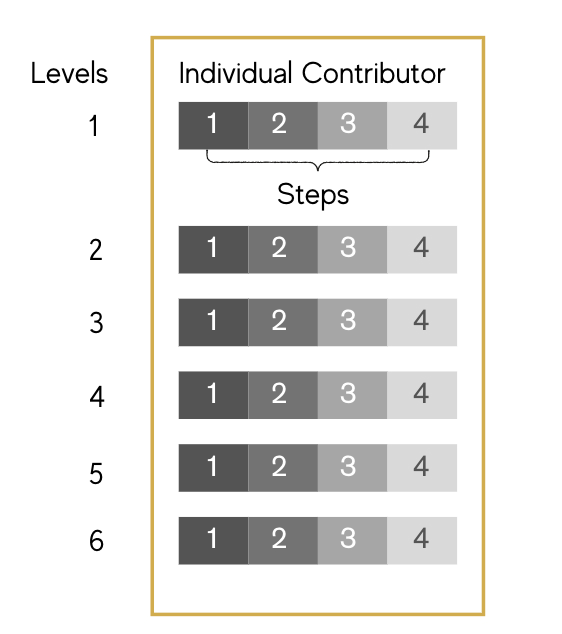
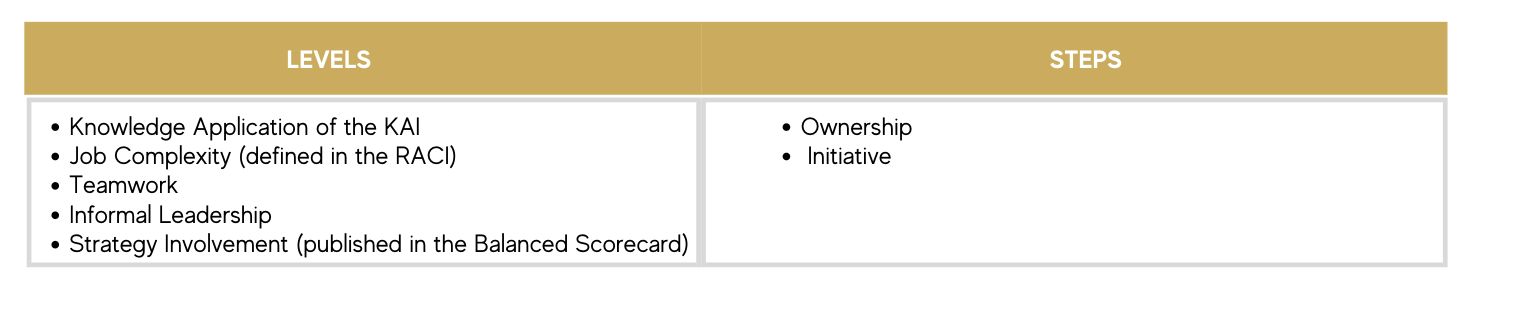
Progress through the IC Path is a journey of expanding knowledge, complexity, and scope. Moving from one level to the next is a significant milestone, while steps within each level mark smaller growth in ownership and initiative.
📊 Structure: 6 Levels, 4 Steps Each
📈 6 Levels of Growth
From foundational skills to company-wide expertise and strategic leadership.
🪜 4 Steps Per Level
Each level has 4 steps that track incremental progress in ownership and initiative.
🎯 Clear Criteria
Advancement is based on well-defined, transparent evaluation criteria and KAI scores.
🔍 How Scope Expands Across Levels
As you advance, your work scope grows—from team-level contributions at Levels 1-2, to department-wide impact at Level 3, cross-department projects at Levels 4-5, and company-wide strategic work at Level 6.
| Level | Scope of Work | Example Focus |
|---|---|---|
| Level 1-2 | Team projects | Building features, fixing bugs, supporting team goals |
| Level 3 | Department-wide | Leading initiatives that affect multiple teams |
| Level 4-5 | Cross-department | Architecting systems, establishing standards, mentoring |
| Level 6 | Company-wide | Strategic technical leadership, shaping product direction |
📋 Evaluation Criteria
To move through the IC Path, you must:
- Meet the criteria outlined in the Level & Step Chart
- Achieve the minimum grade according to the Knowledge Accountability Index (KAI)
🎯 Individual Contributors: The 5 Evaluation Dimensions
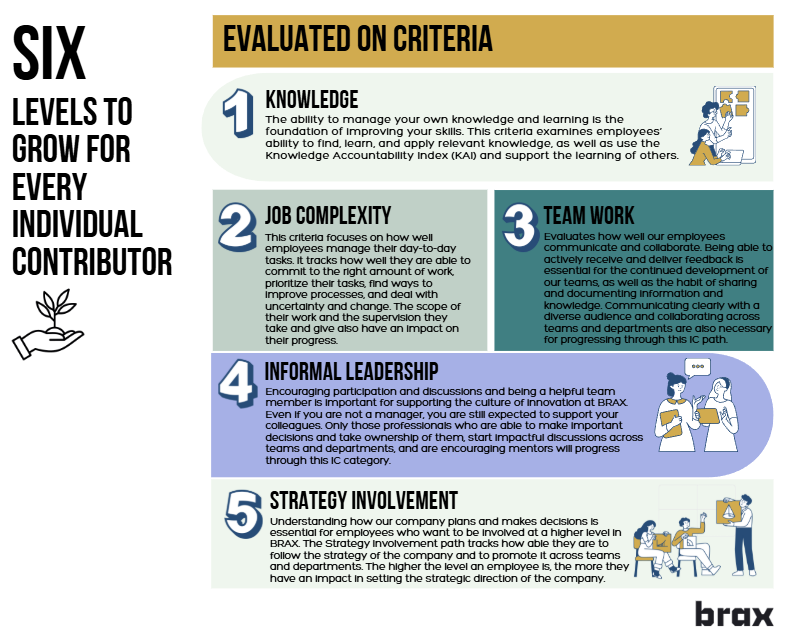
Each level and step is evaluated across five key dimensions that reflect both technical excellence and organizational impact. Below is a detailed breakdown of what each dimension measures.
🚀 Interactive Level Explorer
📚 1. Knowledge 
The ability to manage your own learning is the foundation of skill development. This dimension evaluates how well you find, learn, apply, and share knowledge—including your use of the Knowledge Accountability Index (KAI).
What we assess: - Ability to independently find and apply relevant knowledge - Consistent use of the KAI to track learning and competency - Support for others' learning through documentation, mentorship, and knowledge sharing
⚙️ 2. Job Complexity
This dimension focuses on how well you manage your day-to-day work—committing to the right tasks, prioritizing effectively, improving processes, and navigating uncertainty.
What we assess: - Ability to commit to realistic workloads and meet deadlines - Task prioritization and process improvement - Handling ambiguity, change, and complexity - Scope of work and level of supervision required
Job Complexity is further defined in our Responsibility Assignment Matrixes (RACI & CODE-KS).
🤝 3. Teamwork
The ability of our teams to collaborate is crucial for success. This dimension evaluates communication, feedback exchange, documentation, and cross-team collaboration.
What we assess: - Quality of communication with diverse audiences - Ability to give and receive constructive feedback - Sharing and documenting information and knowledge - Collaboration across teams and departments
💡 4. Informal Leadership
Even without a manager title, you’re expected to support colleagues, encourage innovation, and take ownership. This dimension tracks your ability to lead through influence.
What we assess: - Encouraging participation and constructive discussions - Taking ownership of decisions and their outcomes - Starting impactful cross-team conversations - Mentoring and supporting peers
Only those who can make important decisions, spark meaningful discussions, and mentor effectively will advance in this dimension.
🎯 5. Strategy Involvement
Understanding how we plan and make strategic decisions is essential for higher-level impact. This dimension tracks your ability to follow, promote, and eventually shape company strategy.
What we assess: - Understanding and alignment with company Strategy - Promoting strategic priorities across teams and departments - Contributing to strategic decision-making and planning - Influencing the strategic direction of the company (at higher levels)